
Eddy Current Testing (ET)
WHAT IS EDDY CURRENT TESTING?
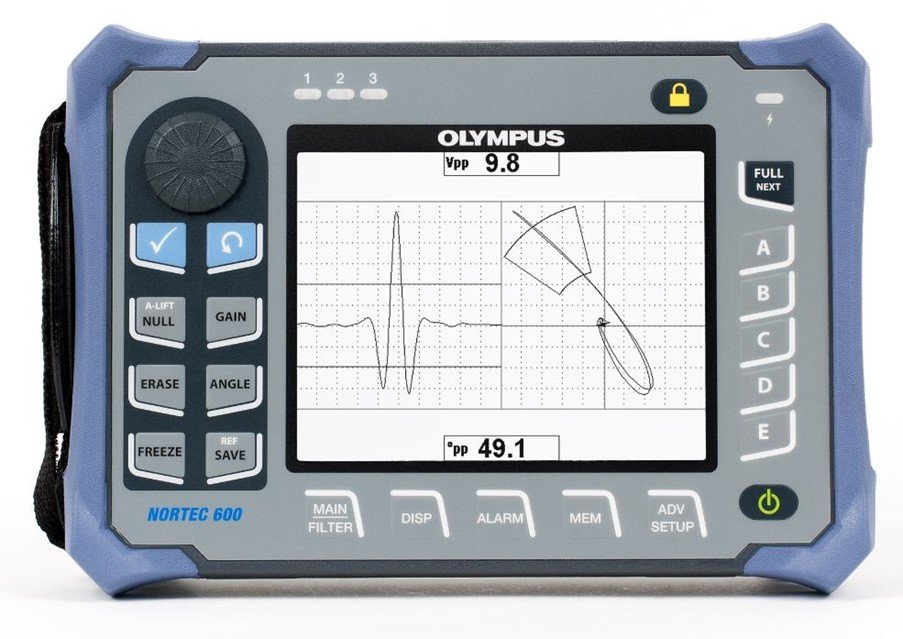
Eddy current testing is a type of advanced NON-Destructive Testing (NDT). It is used to simplify the quality and maintenance of materials, products, and construction at various stages of testing. Eddy current testing is used to determine the best surface and subsurface fault in any portable product or material.
Eddy current inspection concepts are used in a variety of quality control industrial applications. Modern Eddy current NDT techniques have improved functionalities in complex engineering applications such as heat exchanger tube testing, sophisticated Aerospace component testing, and so on.
EDDY CURRENT TESTING PRINCIPLE
A coil of conductive wire is activated with an alternating electrical current in its most basic form, the single-element ECT probe. This wire coil generates an alternating magnetic field in the direction determined by the right-hand rule. The magnetic field oscillates at the same frequency as the coil’s current. When the coil comes into contact with a conductive substance, it induces currents in the material that are diametrically opposing to those in the coil — eddy currents.
Variations in the test object’s electrical conductivity and magnetic permeability, as well as the presence of defects, cause a change in eddy current and a corresponding change in phase and amplitude, which can be detected by measuring impedance changes in the coil, which is a telltale sign of the presence of defects. This is the foundation of conventional (pancake coil) ECT. ECT offers a wide variety of uses. Because ECT is electrical in nature, it can only be performed on conductive materials. There are also physical restrictions to eddy current generation and penetration depth.
ADVANTAGES
- Computerized record keeping: partial.
- Faster inspections.
- Better detection capabilities.
- Easier analysis because of simpler scan patterns.
- Improved positioning and sizing because of encoded data.
- Faster identification, location and isolation of faults.