
Time of Flight Diffraction (TOFD)
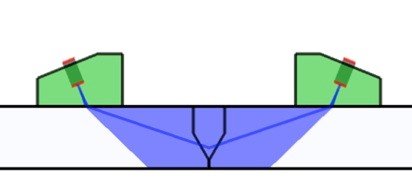
Welding defects can compromise the stability and integrity of a welded structure. When you need confidence in testing of welds, Time of Flight Diffraction (TOFD), a high-performance non-destructive testing (NDT) technique offers you accurate detection of cracks, slag and lack of fusion. We accompany you throughout your testing project and offer you individual solutions.
TOFD uses longitudinal waves passed between ultrasonic sensors to detect, locate, and size flaws based on the time of flight of any diffracted beams. Scaanray utilizes TOFD to rapidly scan heat-affected zones and in-service components to analyze material composition and determine asset integrity
How ToFD Works?
ToFD is an innovation of ultrasonic testing which uses two probes. One probe sends the ultrasound and the other one is used as a receiver. Instead of recording the ultrasound that is reflected by defects, it detects diffraction of sound waves that emanate from the tips of a defect. ToFD inspection provides accurate information about the length and height of defects. Unlike other testing methods, ToFD can detect flaws regardless of their orientation.
TOFD differs from conventional pulse echo ultrasonics in that it depends on diffracted energy rather than reflected energy, monitored in the form of signal height or amplitude. This energy response is then compared to an ‘equivalent’ defect, normally in the form of a side-drilled hole or notch of a specific size for a specific material thickness. TOFD, however, relies on time-based, low energy, diffracted signals from the tips of flaws, allowing an exact or absolute position and size for the flaw to be measured and imaged. The technique is accomplished by using two probes, a transmitter and a receiver; normally placed either side of the weld joint or area to be examined. Because the technique is not amplitude dependent, as in conventional ultrasonics, it does not suffer from the constraints of probe location to flaw orientation, poor coupling, uneven or changing material surfaces. TOFD also uses compression energy only, allowing mode converted signals to be screened out, simplifying the characterization and positioning of flaws. Data from the scan is collected in ‘raw’ form and digitized in RF format (‘A’ Scan).

Merits of Time of Flight Diffraction (ToFD)
- High Probability of Detection (POD)
- Suitable for wide range of materials including plastics such as HDPE
- On stream inspection at temperatures exceeding 400°C
- Applicable on material thicknesses from 5 to 200 millimeters
- No harmful ionizing radiation
- No need to interrupt production
- Exact information about indication length and depth
- Inspection data represented visually
- Direct interpretation of results
- Inspection data available in digital format