
Phased Array Ultrasonic Testing (PAUT)
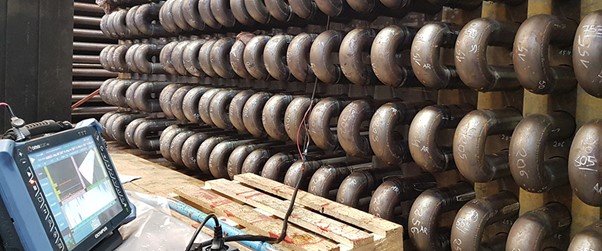
The Phased Array Ultrasonic Testing is a more advanced use of ultrasonic testing technology. It may be used to check welds, detect cracks and flaws, measure thickness, and inspect for corrosion. Because of the thorough visualization of the defect size, shape, depth, and orientation, Phased Array Testing is frequently employed in place of Radiographic Testing. Because it does not employ ionizing radiation, there is no need to set up a safety zone, which would normally imply halting manufacturing.
Why to convert from Conventional UT to Phased Array UT?
Transduces in traditional UT testing features a single unit that generates ultrasonic noises by sending and receiving ultrasonic waves into the material. Multiple components are used in Phased Array probes/transducers to create ultrasonic sound waves. The beam angle, focal point, and focus spot of the produced wavefront may be modified by inserting a delay between the pulses sent out by each constituent. As a result, Phased Array Ultrasonic Testing is a very adaptable technology that may be used for complicated geometries.
Phased Array, with its capacity to gather and encode entire volumetric data, introduces code compliance and auditable outcomes to common Ultrasonic examinations. As a result, Phased Array examination is a more effective and efficient alternative to radiographic inspection. Furthermore, because there are no radiation or environmental concerns, Phased Array inspections may reach radiation sensitive locations, boost project productivity by not displacing other crafts in the area, and maximize on-site and employee safety.

Phased Array Ultrasonic Testing (PAUT) for Boiler Tubes Inspection
Boiler tubes are a key component of steam power and as such are subjected to terrible force. This means that boiler tube weld inspection is crucial to keeping mission-critical operations safe.
Over time, phased array ultrasonic testing (PAUT) has emerged as one of the best means of non-destructive testing (NDT) of boiler tubes. This technique allows for comprehensive inspections that reduce downtime and promote thorough preventative maintenance. The high-speed testing process is uniquely designed to fit the challenging environments and tight spaces most boiler tubes are in. ScaanRay has specialized scanner and that can be used to inspect diameters ranging from 0.84 in. OD up to 4.5 in. OD. It accommodates up to two phased array probes in limited clearance situations.
Advanced NDT Phased Array Ultrasonics Boiler Tube Inspection applications have become almost the norm in many areas of industry today. The benefits of this NON-DESTRUCTIVE testing technology being the ability to store a full inspection record using the Phased Array UT Equipment with its “True to Geometry” visual display capability enhances inspection interpretation. The visual display of combined A-Scan, B-Scan, C-Scan and S-Scan gives a simplified understanding of flaw type and associated dimensions with the additional options of 3D imaging.
Phased Array Inspection Applications
Petrochemical
- Corrosion mapping
- Detection of hydrogen-induced cracking (HIC), stress corrosion cracking (SCC), and stress-oriented hydrogen induced cracking (SOHIC)
- Weld inspection of pressure vessels, piping, and tubing
- Vessels and piping fabricated with composite materials
- Accurate sizing data for fitness-for-service (FFS) calculations
Power Generation
- Turbine blades and Christmas tree designs
- Pressure vessel and piping welds
- Erosion/corrosion mapping
Aerospace
- Friction stir welds
- Composite panels
- Landing gear cylinders
- Titanium billets, forgings and castings
Merits of Phased Array Ultrasonic Testing (PAUT)
- Accurate results
- Quick setup and simple inspection process
- Ability to inspect complex geometries
- Increased inspection speed
- Ability to inspect large areas
- No safety hazards
- Suitable for wide range of materials
- Suitable for complex test piece geometries
- Inspection data represented visually
- Direct interpretation of results